
National Black Reading Month: Reading as Memory, Inquiry, and Community Power
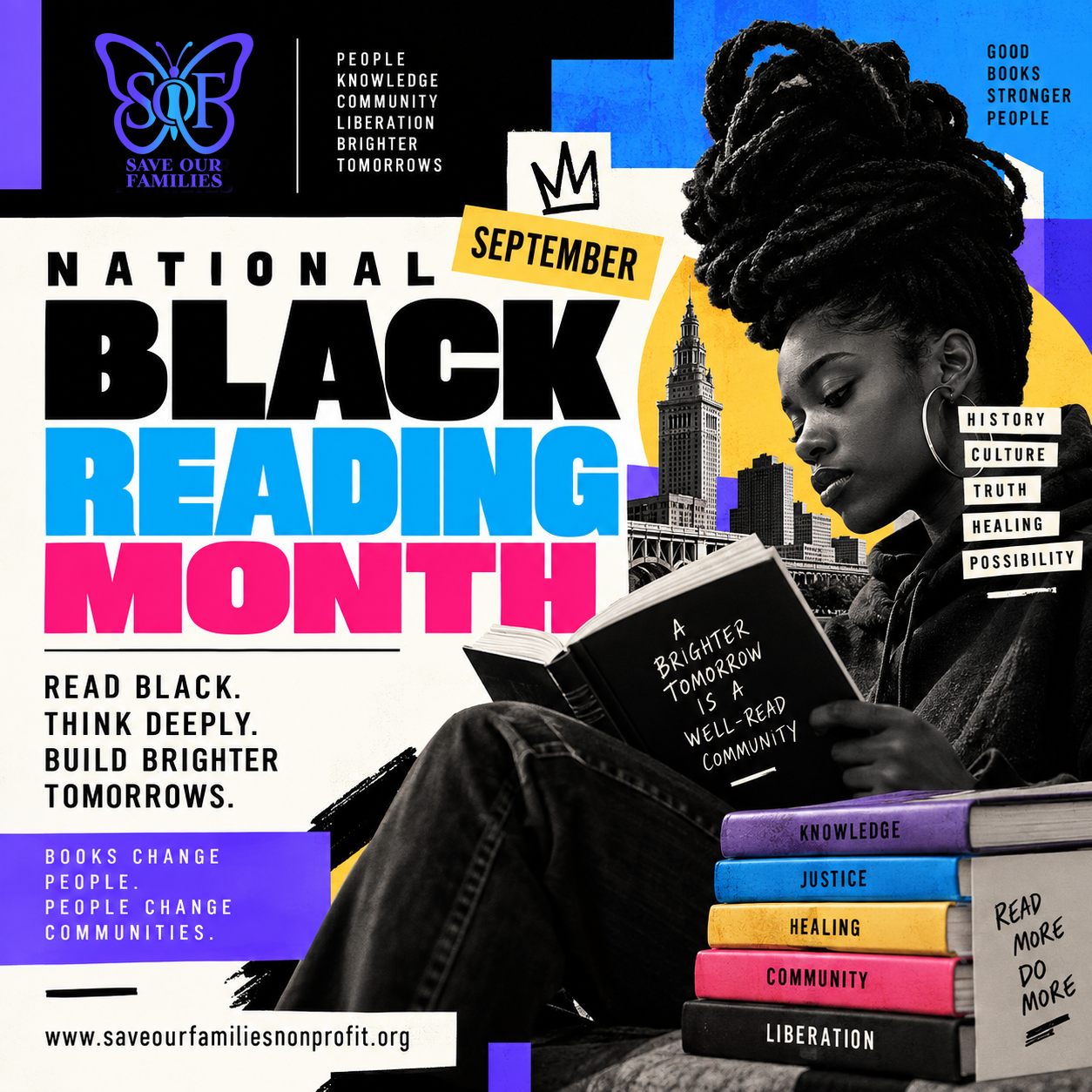
National Black Reading Month: Reading as Memory, Inquiry, and Community Power
Save Our Families recommends five books that examine Black joy, resistance, reparative justice, collective healing, and the political power of storytelling.
We live in an era defined by unprecedented access to information. News reaches us within seconds, social media delivers an endless stream of opinions, and search engines can produce thousands of answers before we have fully formed a question. Yet access to information does not necessarily produce knowledge, and knowledge does not automatically mature into understanding. Much of what we encounter has been shortened, simplified, and arranged for immediate reaction. Complex histories become captions. Public policy becomes partisan theater. Human suffering becomes content. Entire communities are interpreted through fragments selected by institutions, media systems, and algorithms that rarely provide enough context to understand what we are seeing.
Reading demands a different intellectual posture. A serious book asks us to remain with an idea long enough to examine its evidence, assumptions, contradictions, and implications. It allows an author to develop an argument beyond the limits of a headline and gives the reader enough time to evaluate that argument rather than merely react to it. Reading does not require agreement, but it does require sustained attention, intellectual discipline, and a willingness to encounter perspectives that may complicate what we believe we already know.
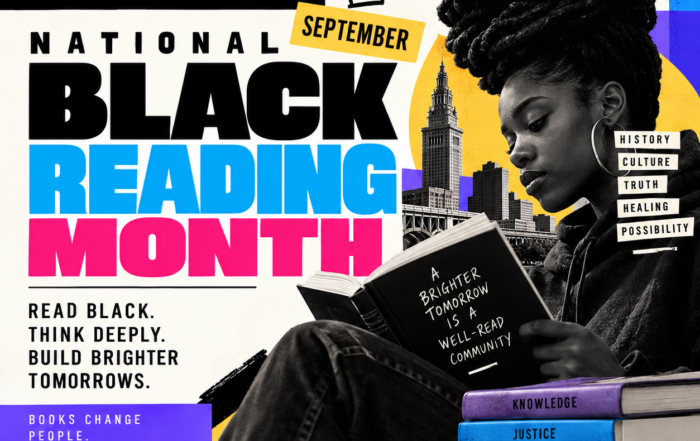
That is why National Black Reading Month deserves more than ceremonial recognition. The observance emerged in Detroit in 1980 as an effort to encourage intentional engagement with books, newspapers, journals, and other works by Black writers. In 1985, Detroit cultural leader Njia Kai introduced the “Turn Off the TV” challenge, encouraging participants to reduce passive media consumption and devote more time to reading. The larger purpose was not simply to increase the number of books people completed. It was to strengthen Black historical and cultural knowledge while supporting Black writers, publishers, bookstores, and intellectual institutions (Detroit PBS, 2022).
This history matters because Black Reading Month raises questions that remain urgent: Whose ideas become part of our intellectual foundation? Whose interpretations of history are treated as authoritative? Which experiences are preserved, and which are reduced, distorted, or omitted? What happens when Black people encounter themselves not merely as subjects of social problems, but as historians, theorists, artists, scientists, policy architects, healers, journalists, and producers of knowledge?
At Save Our Families, education is inseparable from community care. Knowledge helps people identify the systems affecting their lives, place personal experiences within broader social conditions, and develop language for realities they may have struggled to explain. It can reveal how policies shape families, how historical decisions produce contemporary inequities, and how communities have created strategies for survival even when formal institutions failed them. Education cannot resolve every material problem, but communities are more difficult to exploit, dismiss, or mislead when people possess the tools to investigate the world around them.
For National Black Reading Month, Save Our Families selected five books organized around five interconnected themes: joy, resistance, repair, healing, and narrative. These works do not offer a single political program, nor do they approach Black life from one discipline or intellectual tradition. They draw from photography, history, economics, public policy, psychology, organizing, journalism, and cultural criticism. Readers may agree with some arguments, question others, and find that certain conclusions require further evidence or discussion. That intellectual tension is not a weakness in the reading experience. It is part of its value.
Joy as a Historical Record
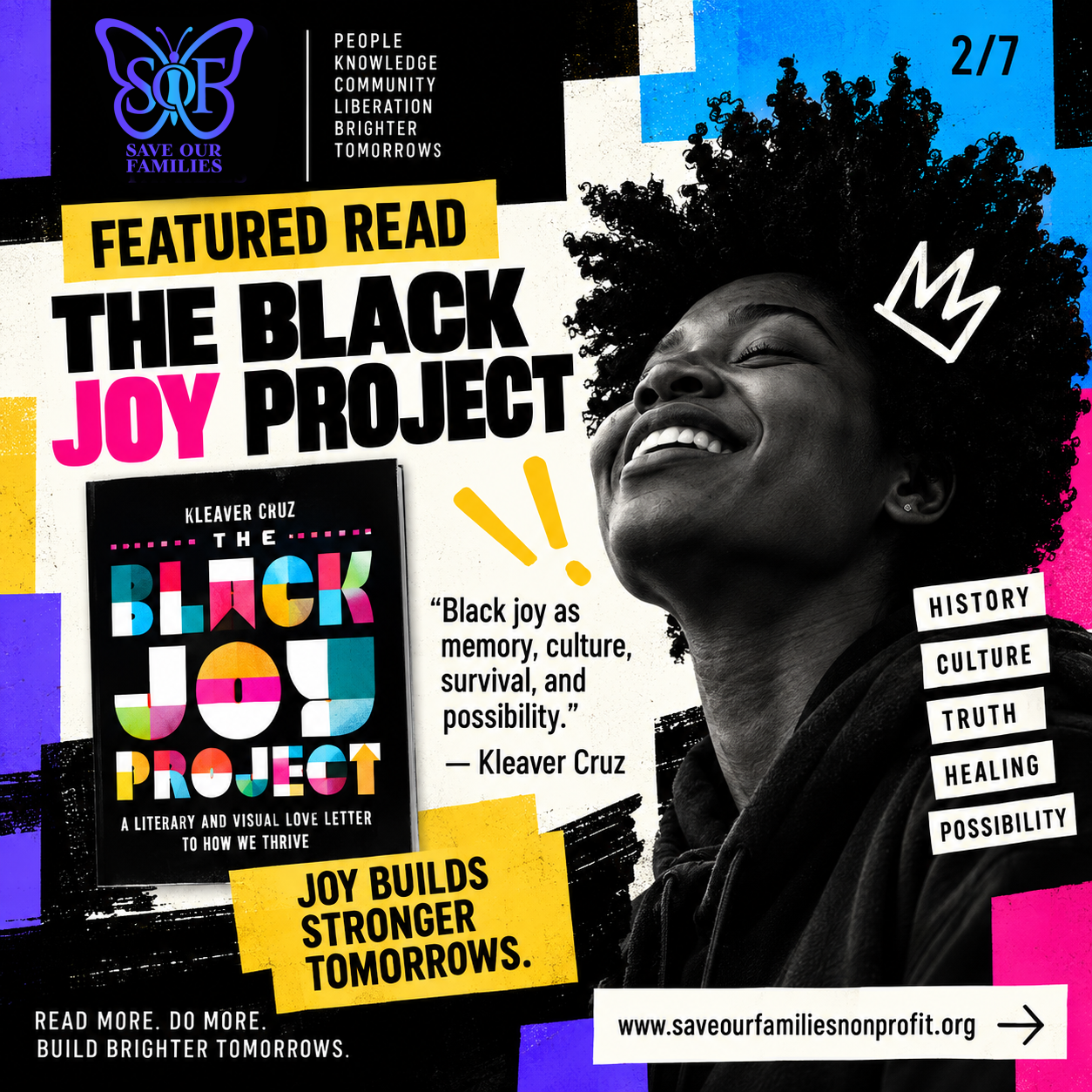
The Black Joy Project by Kleaver Cruz
Public representations of Black life have often been organized around crisis. Slavery, racial violence, segregation, economic exclusion, discriminatory institutions, neighborhood disinvestment, health inequities, and state violence are indispensable parts of the historical record.
These realities must be documented and studied honestly. Yet when Black people are represented almost exclusively through suffering, the resulting account remains incomplete.
Kleaver Cruz’s The Black Joy Project intervenes in that imbalance by treating joy as a serious cultural and historical subject. Through photography and essays, the book documents Black people experiencing celebration, creativity, intimacy, movement, family, friendship, beauty, rest, and belonging. The project grew from Cruz’s effort to circulate images of Black joy during a period when media coverage was saturated with images of Black death and trauma. The completed book preserves those experiences not as distractions from political reality, but as evidence of the fullness of Black life (HarperCollins, 2023).
This distinction is important. Joy is sometimes discussed as if it were merely an emotional reward that appears after hardship has been overcome. Cruz’s work suggests a more substantial interpretation. Joy can function as cultural memory, collective restoration, and resistance to narratives that reduce Black people to injury. A family reunion, a neighborhood celebration, a crowded dance floor, a child laughing without restraint, or an ordinary afternoon among friends may not appear in traditional political archives, but these moments reveal what communities have protected and created despite oppressive conditions.
Archives shape how future generations understand the past. When institutions preserve evidence of Black suffering but overlook the relationships, humor, rituals, art, and everyday pleasures that sustained Black communities, they produce a distorted picture of Black humanity. Pain becomes meticulously cataloged while the reasons people continued building families, friendships, movements, neighborhoods, and cultural traditions become less visible.
The Black Joy Project offers a corrective by insisting that joy is worthy of documentation on its own terms. The book does not deny hardship, and it does not use positivity to conceal injustice. Instead, it challenges the assumption that seriousness requires centering Black suffering at all times. Black joy carries intellectual and political meaning because it reveals the lives, relationships, and possibilities that struggles for justice are ultimately intended to protect.
This book is especially valuable for readers interested in photography, cultural memory, community building, and the politics of representation. It also provides a necessary starting point for this reading list. Before examining resistance, reparations, or healing, we should understand that liberation is not only a struggle against oppressive conditions. It is also a struggle for the ability to live fully within and beyond them.
Resistance Beyond the Simplified Narrative
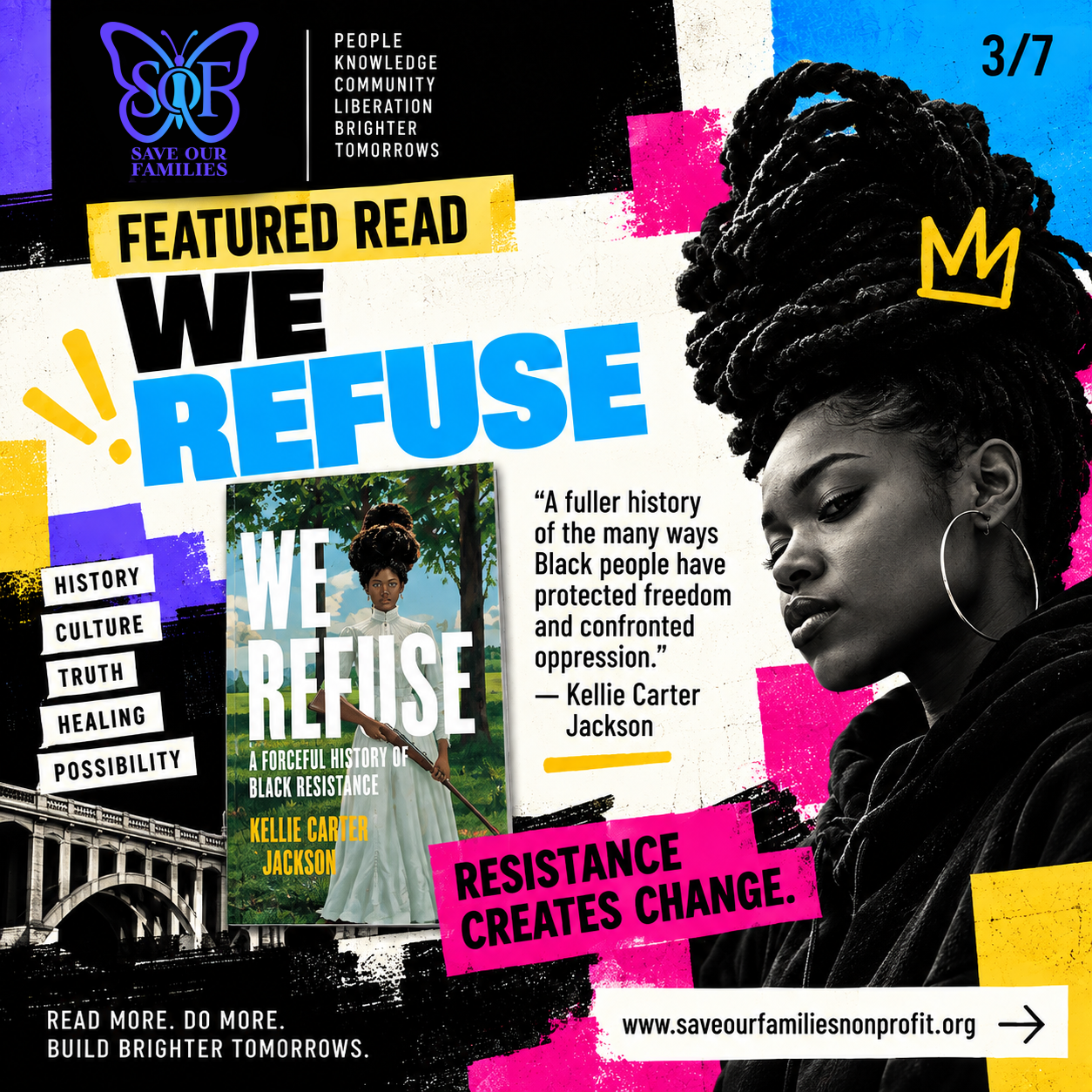
We Refuse: A Forceful History of Black Resistance by Kellie Carter Jackson
American history is frequently taught through simplified oppositions. Black political action is divided into peaceful and violent traditions, integrationist and separatist movements, respectable and radical leaders, or acceptable and unacceptable forms of protest.
These categories may make history easier to summarize, but they often obscure the conditions under which people made consequential decisions about survival, dignity, and freedom.
Historian Kellie Carter Jackson challenges this reduction in We Refuse: A Forceful History of Black Resistance. Jackson examines a broad spectrum of responses to racial oppression, including organized nonviolence, work stoppages, escape, armed defense, revolt, withdrawal, refusal, and the deliberate cultivation of joy. She pays particular attention to strategies developed and practiced by Black women, whose political thought and resistance have often received less attention than the actions of prominent male leaders.
The book rejects the familiar assumption that Black resistance can be adequately understood through a simple contrast between Martin Luther King Jr. and Malcolm X. According to the publisher’s description, Jackson places nonviolent and forceful resistance within a wider historical continuum and examines how Black people have selected different strategies in response to different forms of oppression (Hachette Book Group, 2024).
Jackson’s framework asks readers to confront a difficult question: Who is permitted to define which forms of resistance are legitimate? Dominant institutions frequently celebrate protest movements only after those movements have been stripped of their disruption, conflict, and demands. Historical figures who were once condemned may later be honored through carefully edited narratives that minimize the intensity of their critiques. As a result, the public often receives a version of resistance that is morally comfortable but historically incomplete.
A more rigorous analysis requires attention to context. People confronting slavery, racial terror, labor exploitation, political exclusion, and state violence did not make their choices under neutral conditions. Their decisions were shaped by the threats they faced, the resources available to them, the safety of their families, and their understanding of what forms of action might produce change. Recognizing that complexity does not require readers to endorse every strategy. It requires them to evaluate historical decisions without pretending that oppressed people operated within systems designed to treat them fairly.
We Refuse is therefore more than a catalogue of rebellion. It is an examination of political agency under oppressive conditions. It encourages readers to move beyond sanitized historical narratives and consider the intellectual work involved in resistance: assessing risk, building solidarity, preserving dignity, identifying leverage, and determining when participation in an unjust system becomes a form of surrender.
Readers interested in history, political thought, social movements, gender, or community organizing will find this book especially useful. Its central contribution lies in its insistence that Black resistance has never followed a single script. It has always reflected debate, adaptation, disagreement, courage, and the changing conditions of the struggle for freedom.
Reparations as a Question of Policy and Public Responsibility
The Black Reparations Project: A Handbook for Racial Justice, edited by William A. Darity Jr., A. Kirsten Mullen, and Lucas Hubbard
Reparations is one of the most discussed and least carefully examined subjects in American public life. The term regularly appears in political debates, yet conversations about it are often disconnected from the historical evidence and administrative questions that would shape an actual reparations program. Public discourse frequently stops at whether reparations should exist without seriously examining what such a program would be designed to repair, who would qualify, how eligibility would be established, or what forms redress could take.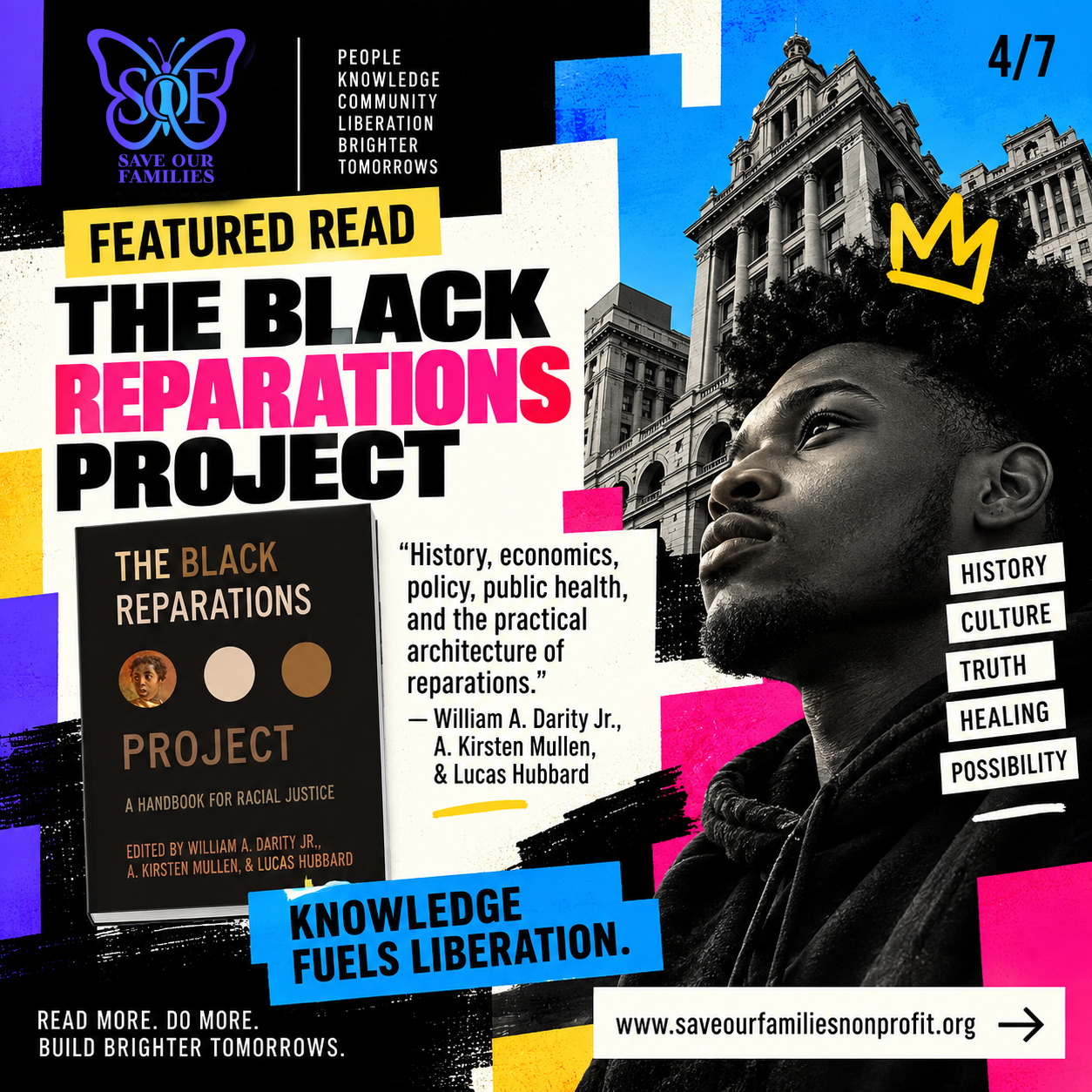
The Black Reparations Project moves the discussion from general principle toward policy design. Edited by William A. Darity Jr., A. Kirsten Mullen, and Lucas Hubbard, the collection brings together scholars working across economics, history, law, public policy, public health, and education. The first portion of the book develops the historical and contemporary case for reparations, while the second examines implementation, including program financing, claimant identification, compensation, genealogy, housing discrimination, educational inequity, health disparities, and draft legislative language (University of California Press, 2023).
The book’s multidisciplinary structure is one of its greatest strengths. The Black American experience cannot be divided neatly into separate economic, political, educational, and health histories. Policies governing property ownership affected the accumulation of wealth. Educational exclusion shaped employment and income. Residential segregation influenced environmental exposure, access to medical care, school funding, transportation, and neighborhood investment. Political exclusion limited the ability of Black communities to challenge these conditions through democratic institutions. The injuries under consideration are interconnected, and any serious analysis of repair must be equally comprehensive.
This complexity is precisely why the topic requires more than slogans. A reader may support reparations while questioning a proposed eligibility standard. Another may agree with the historical analysis but prefer a different method of compensation. A third may begin skeptical and discover that the policy proposals are more developed than public debate suggests. Intellectual engagement requires understanding what is actually being proposed before forming a definitive judgment.
Including this book does not mean that Save Our Families expects every reader to reach the same conclusion. It means we believe the reparations debate should occur at the level of evidence, policy design, historical responsibility, and measurable outcomes. If the central question is how a society should respond to harms that were created through law, protected through public institutions, and transmitted across generations, then the answer cannot be evaluated responsibly without examining the relationship between history and present-day conditions.
The Black Reparations Project is recommended for readers interested in economics, public health, history, law, public administration, racial wealth inequality, or policy development. It demonstrates how reading can move a public conversation beyond symbolic positions and toward the difficult work of defining responsibility, designing remedies, and evaluating whether proposed solutions are proportionate to the harms they claim to address.
Healing Beyond Individual Resilience
What It Takes to Heal: How Transforming Ourselves Can Change the World by Prentis Hemphill
Contemporary wellness culture often treats healing as an individual assignment. People are encouraged to establish better boundaries, regulate their emotions, attend ther
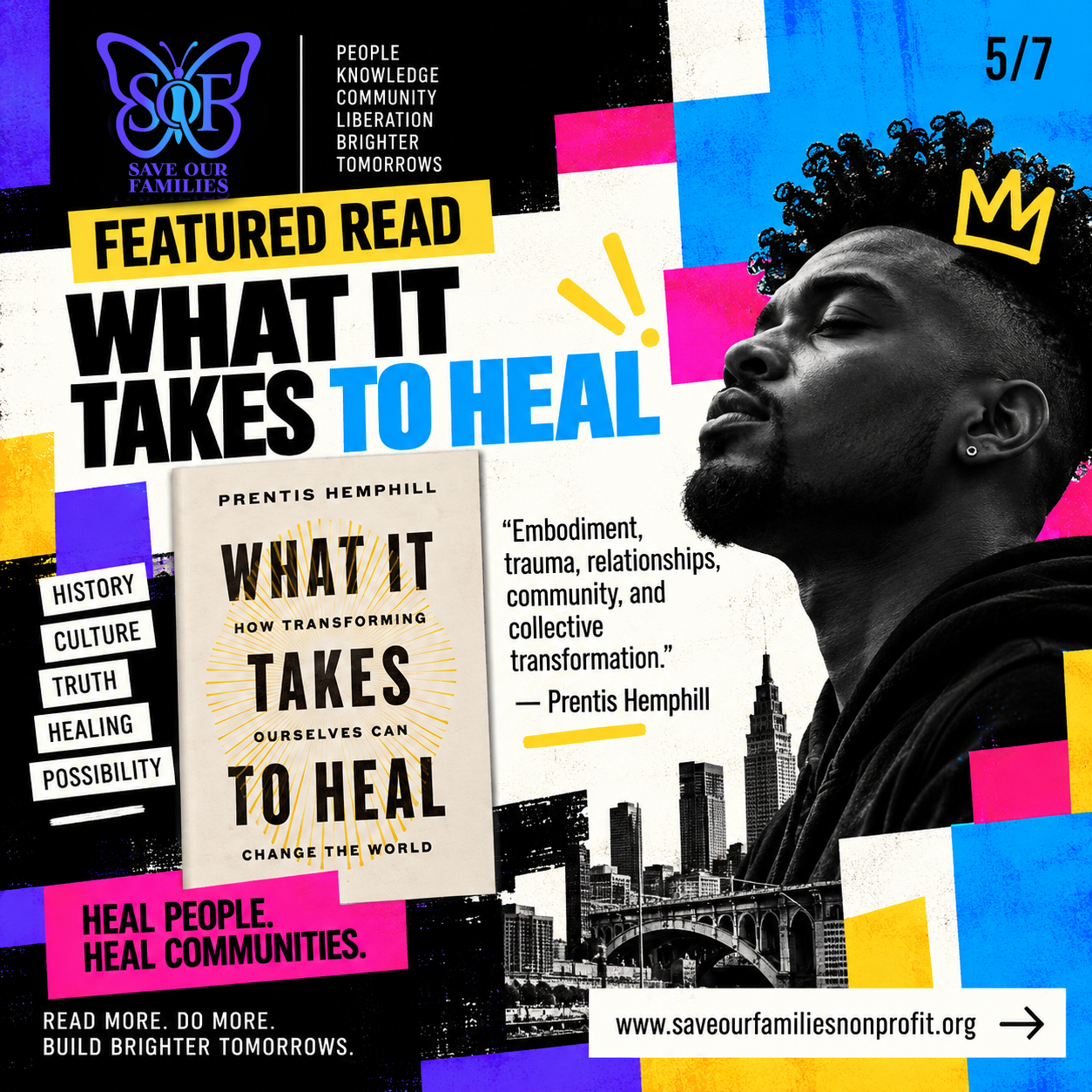
apy, practice mindfulness, become more resilient, and develop healthier coping strategies. Many of these practices can be valuable. The limitation appears when personal resilience is treated as an adequate response to environments that continue producing harm.
Prentis Hemphill’s What It Takes to Heal challenges that limitation by examining healing as both a personal and collective process. Drawing from embodiment practice, therapeutic work, organizing, and lived experience, Hemphill argues that lasting transformation requires attention to the body, relationships, communities, and the structures people inhabit. The book asks what might change if healing were placed at the center of social movements and institutions instead of being treated solely as private work conducted after harm has occurred (Penguin Random House, 2024).
This framework has significant implications for community care. Trauma does not occur outside social conditions. A person may experience instability within a family, but that family may also be confronting poverty, housing insecurity, untreated illness, employment discrimination, neighborhood violence, inaccessible transportation, substance use, or inadequate health care. Individual choices remain important, but individual responsibility alone cannot explain conditions that are repeatedly produced across families and generations.
An exclusive focus on resilience can therefore become politically convenient. It teaches people how to endure harmful environments without requiring those environments to change. It may help someone function within a destructive institution while leaving the institution’s practices untouched. Hemphill’s analysis invites readers to imagine a more ambitious form of healing, one that includes personal transformation but also asks how relationships, organizations, and communities can be redesigned to reduce harm and strengthen connection.
This does not eliminate accountability. In fact, collective healing requires a more demanding understanding of accountability because it asks people and institutions to examine how their actions shape the safety and dignity of others. Healing becomes more than recovering from an injury. It includes changing the conditions that made the injury foreseeable, repeated, or socially acceptable.
For Save Our Families, this argument closely reflects the purpose of community care. Practical support matters because people cannot always begin with abstract conversations about wellness when they lack food, transportation, medical care, safety, or basic supplies. Trusted relationships matter because isolation can deepen crisis. Institutional change matters because communities should not be required to develop endless resilience in response to preventable harm.
Readers interested in psychology, trauma, embodiment, organizing, mental health, relationships, or social change will find Hemphill’s work especially relevant. The book challenges us to understand healing not as a return to a previous condition, but as the creation of new conditions in which people can live with greater safety, connection, agency, and possibility.
Narrative, Power, and the Responsibility to Read Critically
The Message by Ta-Nehisi Coates
Every society constructs stories about itself. These stories explain who belongs, how the past should be remembered, which forms of suffering deserve recognition, and what a nation wishes to believe about its own character. Because narratives help organize public memory, they influence far more than literature. They shape journalism, education, politics, law, foreign policy, and the moral boundaries of public concern.
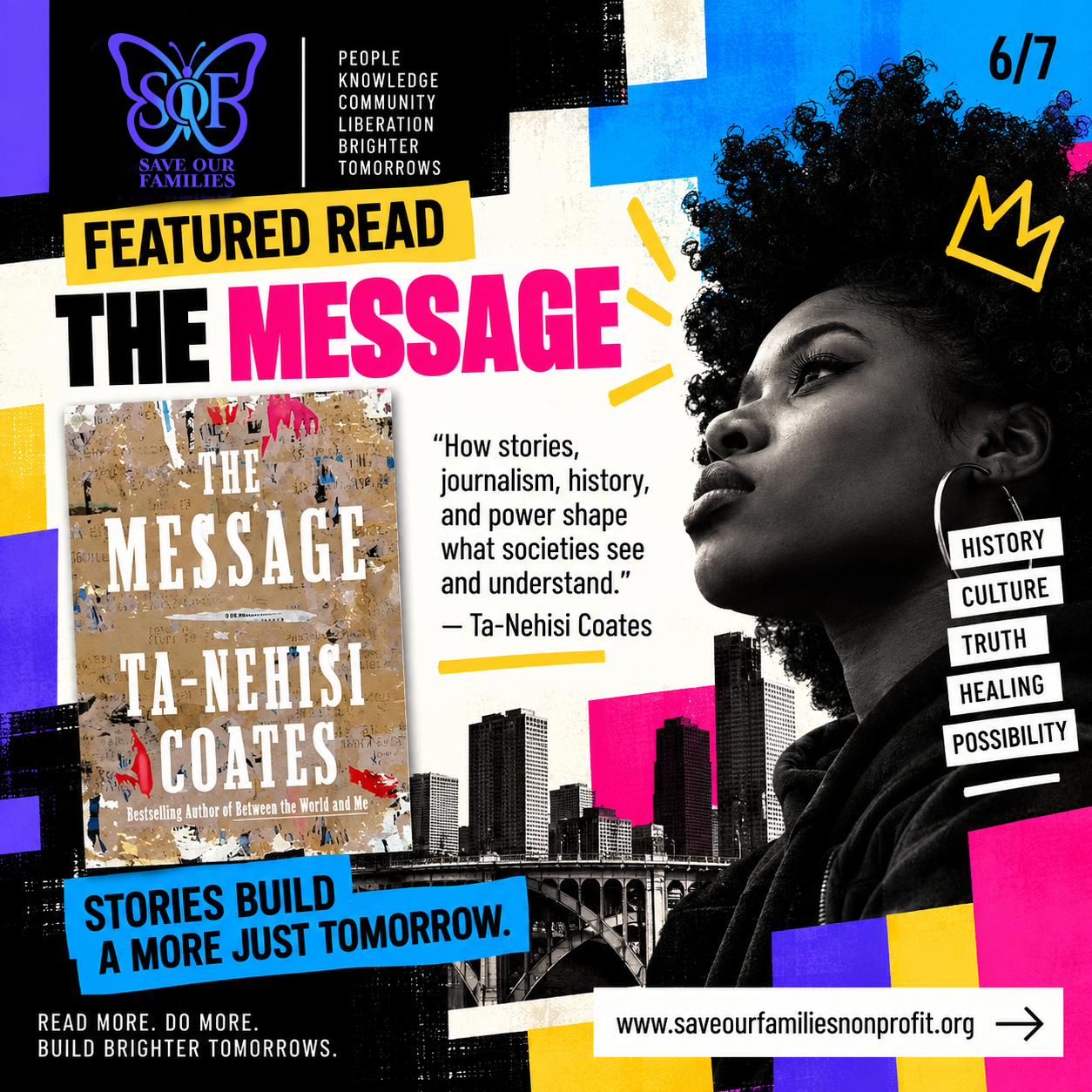
In The Message, Ta-Nehisi Coates examines writing, travel, reporting, identity, and the relationship between storytelling and power. Across three essays, Coates considers how narratives can reveal reality while also softening, distorting, or concealing it. His reflections move through Senegal, South Carolina, and Palestine, connecting personal observation with larger questions about historical memory, political language, and who is permitted to define the meaning of events (Penguin Random House, 2024).
The book is particularly relevant within the contemporary information environment. People now encounter news through social media feeds, short videos, podcasts, search algorithms, artificial intelligence systems, influencers, partisan outlets, and traditional journalism. The abundance of available information may create the appearance of democratic access, but it also places greater responsibility on readers to evaluate sources, framing, evidence, and omission.
Critical reading does not mean approaching every claim with automatic suspicion. It means understanding that information can be factually accurate and still incomplete. A photograph may depict a real event while excluding everything beyond its frame. A statistic may be correct while being presented without the historical or demographic context necessary to interpret it. A political message may rely on carefully selected language that directs attention toward one cause while obscuring another.
Coates’s work encourages readers to interrogate not only the story being told but also the conditions under which it becomes believable. Who created the message? Which sources were considered credible? Whose perspective was centered? What historical background was assumed or omitted? What emotional response was the narrative designed to produce? How might the meaning change if the same event were described by someone positioned differently?
These questions are essential forms of literacy. A reader who understands framing becomes more capable of distinguishing evidence from interpretation and less vulnerable to manipulation through repetition, selective context, or emotionally charged language. Such a reader may still arrive at a strong conclusion, but that conclusion is more likely to emerge from analysis than from reflex.
The Message is recommended for readers interested in journalism, cultural criticism, history, political communication, media literacy, or the craft of writing. Its inclusion completes the intellectual arc of this reading list because narrative influences how we understand every other theme. Joy must be represented. Resistance must be interpreted. Reparative justice must be debated. Healing must be conceptualized. In each case, the language used to describe the issue helps determine what the public is prepared to believe is possible.
Black Intellectual Life Cannot Be Confined to One Subject
Taken together, these five books create a multidimensional portrait of Black thought. Cruz examines joy as cultural memory and a declaration of full humanity. Jackson complicates inherited narratives about resistance and political legitimacy. Darity, Mullen, Hubbard, and their contributors translate the demand for repair into questions of evidence, eligibility, implementation, and public responsibility. Hemphill connects personal healing to relationships, institutions, and collective transformation. Coates examines the narratives through which people interpret history, identity, and power.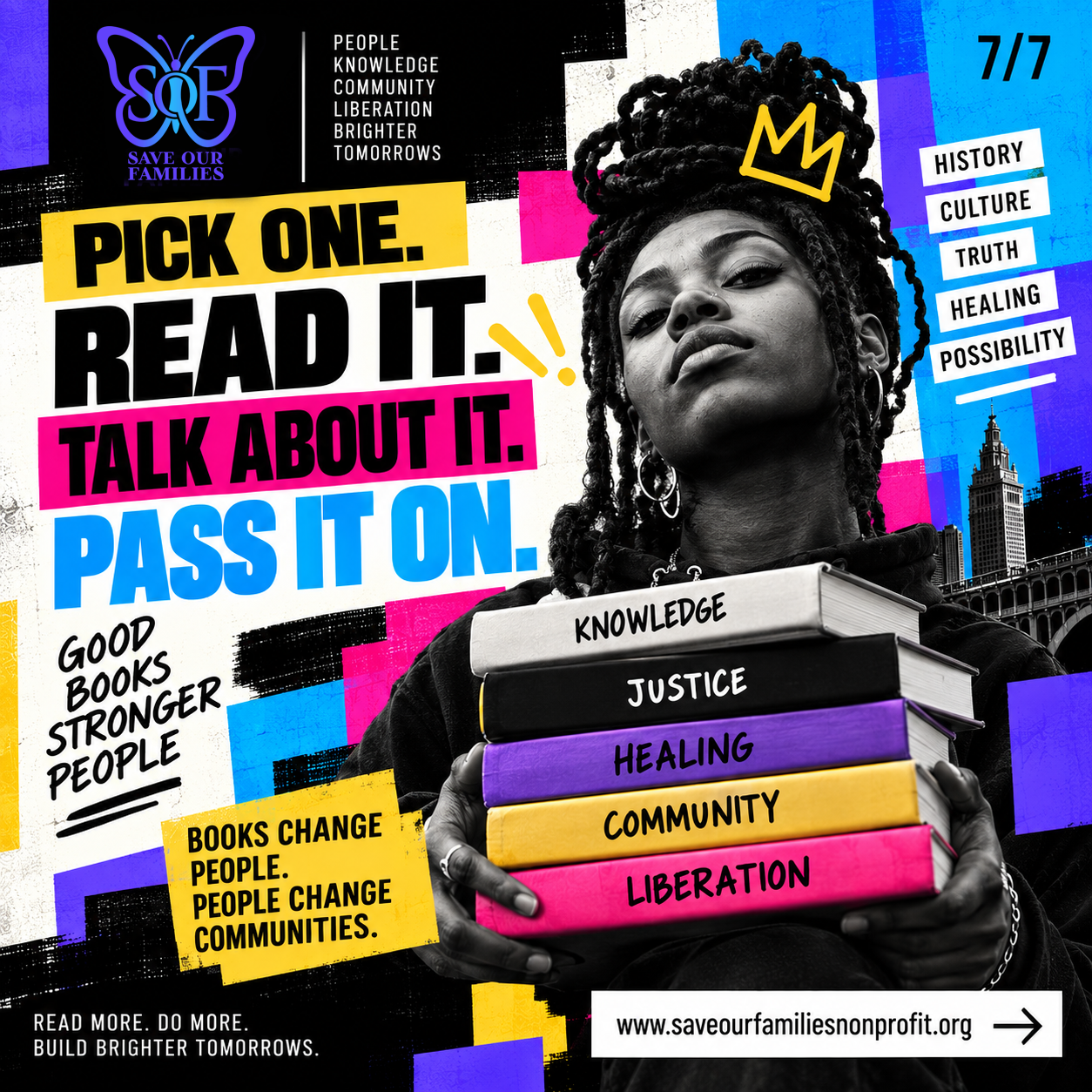
The collection also makes a broader argument: Black intellectual life cannot be contained within the category of Black history. Black writers contribute to psychology, economics, public health, journalism, environmental studies, political theory, education, technology, art, philosophy, literature, design, and every other field through which human beings attempt to understand the world.
Black Reading Month should not become a period in which Black readers are expected to consume only books about oppression. Those books remain necessary, especially when historical truth is being challenged or suppressed, but Black curiosity should never be restricted to the subjects that institutions have traditionally associated with Black life. We should read about racism and reparations, but we should also read Black science fiction, romance, architecture, business, spirituality, queerness, comedy, nature, parenting, technology, fantasy, and love.
Black writers should be permitted the full range of intellectual and creative expression. Black readers should be encouraged to pursue the full range of human curiosity.
From an Awareness Month to an Intellectual Practice
The value of National Black Reading Month will not be measured by the number of graphics posted during September. Its deeper value will be measured by whether reading becomes a sustained community practice.
That practice can begin modestly. Choose one book by a Black writer and commit to reading it carefully. Mark the passages that challenge you. Research the historical references you do not recognize. Identify the evidence supporting the author’s argument. Notice where the analysis feels incomplete. Discuss the work with someone whose perspective differs from your own. Recommend it to a young person, share it with an older relative, or use it to begin a conversation within a school, workplace, faith community, neighborhood group, or family.
Support Black bookstores and libraries when possible. Read contemporary writers, but also return to authors whose work helped build the intellectual traditions we now inherit. Include Black authors throughout the year rather than restricting them to a designated month. Most importantly, resist the temptation to build a reading life in which every author confirms what you already believe. The purpose of reading is not intellectual obedience. Its purpose is intellectual expansion.
A meaningful reading practice should refine our questions, deepen our historical understanding, improve our ability to evaluate evidence, and enlarge our capacity to imagine social conditions that do not yet exist. Some books will affirm us. Others will unsettle us. A few may change how we understand ourselves, our communities, or the responsibilities we hold toward one another.
National Black Reading Month offers a simple invitation with serious implications: choose a book, engage it fully, discuss what it taught you, and keep the knowledge moving.
When books move through communities, reading becomes more than an individual accomplishment. It becomes a shared form of memory, inquiry, and power.
Save Our Families Recommended Reading List
- The Black Joy Project by Kleaver Cruz
Primary theme: Black joy, cultural memory, photography, and representation - We Refuse: A Forceful History of Black Resistance by Kellie Carter Jackson
Primary theme: Resistance, political agency, historical complexity, and Black women’s leadership - The Black Reparations Project: A Handbook for Racial Justice, edited by William A. Darity Jr., A. Kirsten Mullen, and Lucas Hubbard
Primary theme: Reparative justice, economics, public policy, public health, and implementation - What It Takes to Heal: How Transforming Ourselves Can Change the World by Prentis Hemphill
Primary theme: Trauma, embodiment, collective healing, relationships, and community transformation - The Message by Ta-Nehisi Coates
Primary theme: Storytelling, journalism, historical memory, media literacy, and power
Choose one. Read deeply. Think critically. Share what you learn.
All of these books can be found for free through the Libby App.
References
Coates, T.-N. (2024). The message. One World. https://www.penguinrandomhouse.com/books/653438/the-message-by-ta-nehisi-coates/
Cruz, K. (2023). The Black joy project. Mariner Books. https://www.harpercollins.com/products/the-black-joy-project-kleaver-cruz
Darity, W. A., Jr., Mullen, A. K., & Hubbard, L. (Eds.). (2023). The Black reparations project: A handbook for racial justice. University of California Press. https://www.ucpress.edu/books/the-black-reparations-project/hardcover
Detroit PBS. (2022, September 20). September is Black Reading Month encourages people to read Black authors, understand Black history. https://www.detroitpbs.org/news-media/american-black-journal/september-is-black-reading-month-encourages-people-to-read-black-authors-understand-black-history/
Hemphill, P. (2024). What it takes to heal: How transforming ourselves can change the world. Random House. https://www.penguinrandomhouse.com/books/726173/what-it-takes-to-heal-by-prentis-hemphill/
Jackson, K. C. (2024). We refuse: A forceful history of Black resistance. Seal Press. https://www.hachettebookgroup.com/titles/kellie-carter-jackson/we-refuse/9781541602908/
about author

Created by the team at Save Our Families.
subscribe to our newsletter
Join the Save Our Families newsletter for updates on community care, mental health tools, healing stories, and events you won’t want to miss.
Note: We promise not to flood your inbox—just healing vibes, resources, and real talk.
Recent Posts
Preparedness Is Community Care: Building Safety Before an Emergency Happens
Preparedness Is Community Care: Building Safety Before an Emergency Happens Every September, National Preparedness Month calls attention to a simple but consequential truth: emergencies rarely provide enough time to begin planning after they arrive. Severe [...]
National Black Reading Month: Reading as Memory, Inquiry, and Community Power
National Black Reading Month: Reading as Memory, Inquiry, and Community Power Save Our Families recommends five books that examine Black joy, resistance, reparative justice, collective healing, and the political power of storytelling. We live in [...]

National Voter Registration Day 2026: Register to Vote in Ohio
September 15 is National Voter Registration Day, a nationwide reminder that every eligible voter deserves the opportunity to participate in the decisions shaping their community. Voting affects the systems surrounding our everyday lives, including schools, [...]

