
Juneteenth: Celebrating Black Freedom, Excellence, and Resilience
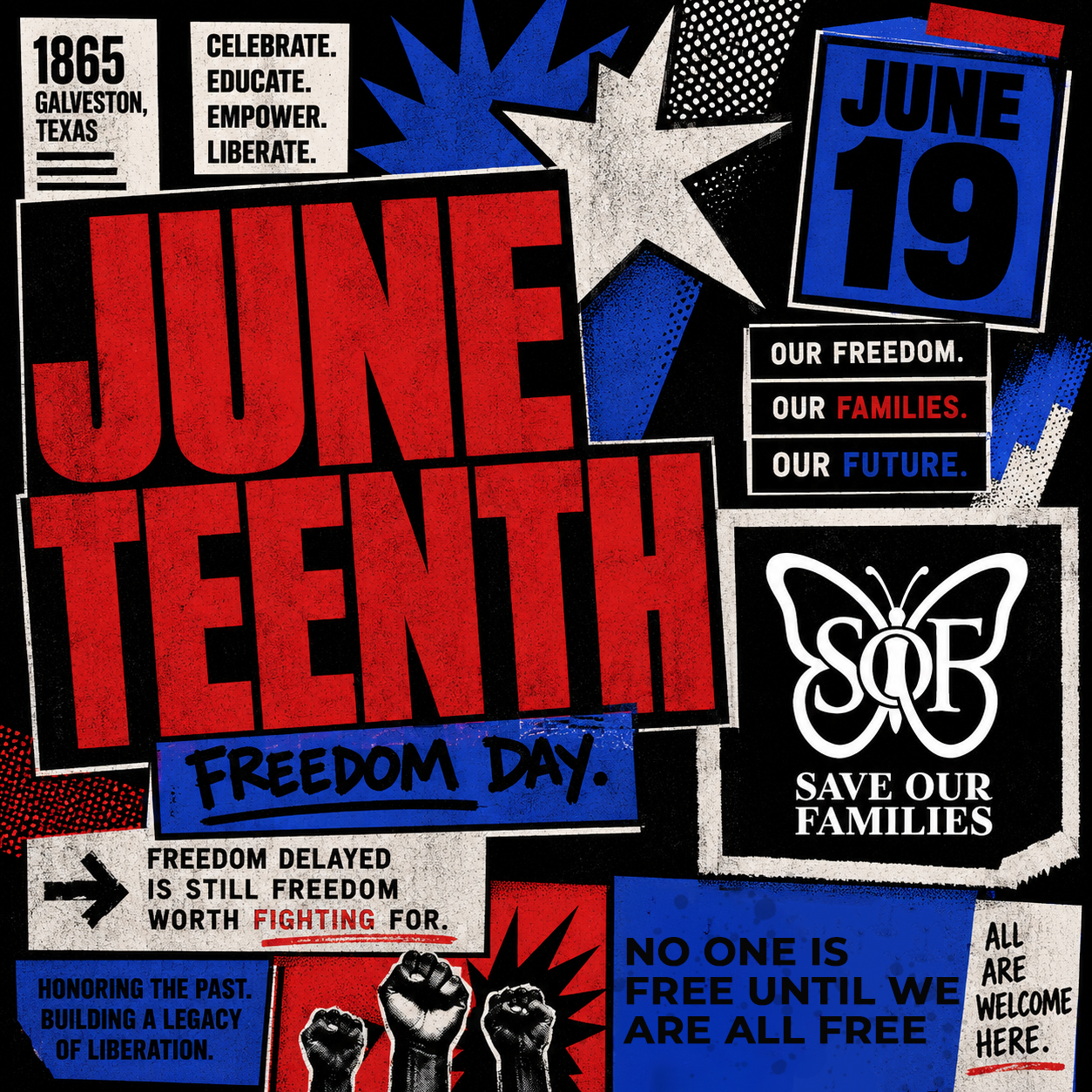
“Charlotte Brooks was seventeen when she was torn from her family and carried to a plantation in Texas, where the people who claimed her ruled by violence. One day, hidden in the kitchen, she overheard the secret her enslaver was guarding with everything he had. Slavery had been abolished. The people he held had every right to walk free, and he had buried that truth so he could go on stealing their labor. Brooks did not wait to be told. She stepped out of her hiding place, declared herself free, carried the news across the plantation, and ran. That night she came back for her daughter, Tempie, and the two of them were gone, finally free.” – Karlos K. Hill and Soraya Field Fiorio
Her story is the truth at the center of Juneteenth, and it is not the story we are usually handed. The familiar version says that freedom simply traveled slowly, that word had not yet reached the far edge of Texas, and that Union troops arrived one June morning to deliver the news at last. That version is gentle, and it is wrong. Freedom did not fall behind because of distance. It was withheld, deliberately and by force, by enslavers determined to keep people and profit in their grip for as long as they could. And it was claimed, again and again, by Black people who had been resisting bondage from the very beginning.
That resistance is older than the announcement at Galveston. For generations, enslaved people fought their captivity by escaping, breaking tools, refusing, and rising in revolt. When the Civil War came, roughly 200,000 Black men enlisted in the Union ranks and took up arms for the freedom of their own families. Emancipation was never a gift bestowed from above. It was pried loose by the people who had the most to gain and everything to lose.
The law caught up to that struggle slowly and unevenly. In 1862, slavery was abolished in Washington, D.C., freeing more than three thousand people. On January 1, 1863, the Emancipation Proclamation promised freedom to the millions held in the Confederate states, yet it could not reach the roughly half a million people still enslaved in the loyal border states, and it could not be enforced anywhere the Confederacy still held power. A proclamation is only as strong as the force willing to back it. Across vast stretches of the South, enslavers simply ignored it. Texas, far from Union lines, became a destination where enslavers carried people precisely to keep them in bondage, evading abolition until they were forced to stop.
That is what changed on June 19, 1865. When General Gordon Granger and his troops marched into Galveston and issued the order announcing that all enslaved people in Texas were free, the news they carried was not new. Freedom had belonged to those people for more than two years. What arrived that day was the force that finally made concealment impossible. Even then, the order told the freed to stay and work for wages, and even then, people in the border states remained legally enslaved. Slavery was not formally ended across the nation until the Thirteenth Amendment, passed by Congress on January 31, 1865, and ratified on December 6 of that year, months after the Confederate surrender at Appomattox.
Because emancipation arrived in pieces, on different days in different places, communities marked it on the dates that carried meaning for them. The people of Galveston began celebrating on the first anniversary of Granger’s order and named the day Juneteenth, combining June and the nineteenth into a single word. Small gatherings grew into parades, and over time, Juneteenth became the most widespread of all the emancipation celebrations. Yet the end of chattel slavery did not end racial oppression, terror, or the daily work of survival. To celebrate emancipation under those conditions was itself an act of resistance, a refusal to let the world forget what had been won and at what cost. Not until 2021 did Juneteenth become a federal holiday.
This is why the framing matters. When we say that troops came and told them, we hand the dignity of the day to the messenger and leave the enslaved standing silent, waiting. The truth honors them properly. Freedom in Texas was concealed by people who profited from the lie, and it was uncovered, declared, and spread by people like Charlotte Brooks, who heard the truth and made it real with her own voice and her own feet. Juneteenth belongs to them.
Sources
- Karlos K. Hill and Soraya Field Fiorio, “What is Juneteenth, and why is it important?” TED-Ed lesson, video, https://youtube.com/watch?v=lq8TNKZVEWs.
- Graham Hodges, “The Origins of Juneteenth,” in Emancipation and Juneteenth, 1862–1865, by Jason Butler (New York: Gilder Lehrman Institute of American History, 2024).
- National Museum of African American History and Culture, “The Historical Legacy of Juneteenth,” Smithsonian Institution, https://nmaahc.si.edu/explore/stories/historical-legacy-juneteenth.
- Abraham Lincoln, “The Emancipation Proclamation,” January 1, 1863, transcript, Featured Documents, National Archives, https://archives.gov/exhibits/featured-documents/emancipation-proclamation.
- General Order No. 3, Headquarters, District of Texas, Galveston, June 19, 1865, Records of US Army Continental Commands, 1817–1947, National Archives and Records Administration, https://catalog.archives.gov/id/182778372.
- Joint Resolution Proposing the Thirteenth Amendment to the United States Constitution, February 1, 1865, Record Group 11, National Archives, https://catalog.archives.gov/id/1408764.
about author

Created by the team at Save Our Families.
subscribe to our newsletter
Join the Save Our Families newsletter for updates on community care, mental health tools, healing stories, and events you won’t want to miss.
Note: We promise not to flood your inbox—just healing vibes, resources, and real talk.
Recent Posts
Safety Is a Right: When Domestic Violence and Stalking Intersect
No one should have to earn safety! Every person deserves relationships where their boundaries matter, their choices belong to them, and their home offers room to breathe. When someone uses fear, humiliation, isolation, surveillance, or [...]
National Self-Awareness Day: Reflection Without Judgment
National Self-Awareness Day: Reflection Without Judgment Every person carries an internal world shaped by emotions, needs, memories, values, habits, expectations, and relationships. Much of that world influences our decisions before we consciously recognize what is [...]
Preparedness Is Community Care: Building Safety Before an Emergency Happens
Preparedness Is Community Care: Building Safety Before an Emergency Happens Every September, National Preparedness Month calls attention to a simple but consequential truth: emergencies rarely provide enough time to begin planning after they arrive. Severe [...]

